
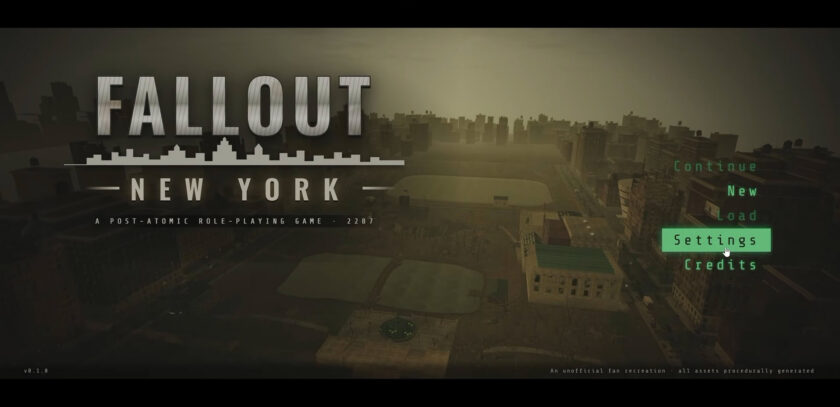
“The suits got involved and the fun is over.” Fallout: New York — a free browser game written almost entirely by an AI model — is offline after its creator received a cease-and-desist notice from Bethesda parent ZeniMax Media. X user Chris First revealed the project on September 28, and the reveal video passed 3.5 million views. On October 1, First confirmed he was abandoning the game after receiving the legal threat, and the project has since been set to private. Bethesda hasn’t commented publicly.
“Hey, Bethesda Studios, how about you make a Fallout game instead so I don’t have to?” First wrote alongside a screencap of the notice. “Sorry to everyone who enjoyed the game!”
An Entire Fallout Game, Generated by Code
Built with Claude Opus 5.5, the project was remarkably ambitious for something an AI wrote: 117 locations, 112 characters and 46 weapons, along with quests, dialogue trees, V.A.T.S. and a working Pip-Boy. It shipped without a single texture or sound file — “every building, weapon, face, and sound is generated by code,” First explained. The notice reportedly told the creator that ZeniMax, as a trademark owner, is obliged to “monitor and enforce against the unauthorized and infringing use of its trademarks.”
A game using the Fallout name was always going to attract the lawyers, free or not. But the takedown is also a milestone of sorts: one of the first viral, fully AI-generated games to be killed by the IP it borrowed.
Part of a Wider Crackdown on AI-Built Games
Fallout: New York isn’t the only “vibe coded” project to get legal attention this week. Maurice Heumann, who has been using generative AI agents — “17 agents working in parallel” — to decompile the original Modern Warfare 2 on PC, saw Activision disable his showcase footage with a copyright report, and the link to the site hosting the code no longer works. Days earlier, Take-Two sent a cease-and-desist to a project trying to bring GTA 5 to Android — part of the same wave of publisher enforcement that recently saw Rockstar tighten its GTA modding rules.
As Kotaku notes, it’s unclear how long this whack-a-mole approach can last when AI-built projects that seemingly infringe famous gaming IP go viral every other day — while the big publishers have yet to mount a legal battle against the AI companies themselves. For its part, Bethesda has confirmed four official Fallout games in development, with inXile Entertainment also reportedly working on one.